The Straits Times, March 6, 2007
By Cheong Suk-Wai, SENIOR CORRESPONDENT LARD-DEE-DA: It's hard to resist the ubiquitous lard-laden speciality, char kway teow,nicely washed down with teh tarik. -- WANG HUI FEN, CHEONG SUK-WAI
Something is a-stirring and it's aromatic: Yes, Penang street hawkers continue to reign supreme in Asia. Forget franchises. It all boils down to family secrets
SHAKESPEARE had it that music is the food of love.
But for my younger sister and me, music begat our love of food.
That's all thanks to piano lessons in Penang every Friday for five years in the 1980s. As the Malaysian city was then a two-hour drive from my home in Sungai Petani, Kedah, we got to enjoy the world's street-food paradise that is Penang once a week.
Back home on Chinese New Year leave last month and fed-up with festive fare, my sister and I decided to retrace the Friday flavours of our childhood with an impromptu makan marathon around Georgetown, the capital of Penang state.
It has been 20 years since our last piano lesson, but given that the city's most famous hawker stalls were founded as early as 1923 and are still chiefly run by their founders' families, chomping our way down memory lane would be a cinch.
First stop, Georgetown's central wet market of Pulau Tikus, which is Malay for Rats' Island - apt, as the fat and furry rodents skitter about the drains and floors in broad daylight. As they say, the fatter the rats, the better the grub.
And good grub is rarely better than my RM2.50 (S$1.10) plate of Tan Choo Hoon's char kway kak (flash-fried rice flour cubes with chives and beansprouts) at Stall 17.
Redolent of freshly rendered lard, dark soy sauce and garlic, it's the deeper-flavoured sister of Singapore's chye tow kway (carrot cake).
My sister bides her time till we hotfoot it to one of Penang's hottest no-signboard pushcarts outside the old Kwai Lock Coffeeshop for her favourite breakfast of apom balik, a sweet rice flour wafer with just a waft of coconut.
The pushcart's current owner, Mr Tan Eng Huat, 58, says his late mother, Madam Seng Ah Poh, sold apom at the same spot for 40 years. Now his wife, Madam Yeoh Kooi Khim, 56, keeps apom aficionados happy.
As of last year, Kwai Lock also boasts the only branch of Penang's famous Hutton Lane soup kway teow - thin springy rice ribbons with shredded meat and fishballs in superior stock. For this, Penangites give thanks, as parking is notoriously difficult in Hutton Lane.
Along the way, we hail two newer Pulau Tikus mainstays.
There's Mr Joe Jaganathan Veloo, 46, who's been selling 200 pandan-flavoured putu mayam (stringhoppers) a day out of his van for the past 15 years.
Every fluffy mouthful is like chewing a cloud, with bursts of gula melaka and freshly grated coconut solid enough to tide you over till lunchtime.
But in Penang, no one waits that long for his next bite. Just ask Madam Rosnah Saidi, 40, who hails from Jurong East but settled in Penang after her arranged marriage 19 years ago.
She and her husband Adam Zaibis, 40, started selling Penang's best RM1 nasi lemak and fiery-crisp RM1 curry puffs in 2002, shortly after he was retrenched from his factory job. Now, they sell about 800 packets of nasi lemak and about 1,000 curry puffs every day, with help from their three kids - and three maids.
We stagger on. In the Sin Hwa Coffeeshop, we bump into an Indonesian maid taking a just-washed wok out to Madam Song Lee Lean, 50, whose drier version of Penang char kway teow is studded with crisp crackling bits. It's 35 years of chive- and chilli-flecked perfection on a plate.
We are her first order of the day and within five minutes, 17 of her fans crowd around all of Sin Hwa's nine tables.
Madam Song took over the stall after her father Song Ah Lek died 10 years ago. She stops frying at 5pm daily, but her younger brother Song Wee Chye fries at Pulau Tikus Market at night (she's better by far).
This, then, is the secret to Penang's continued supremacy among street hawkers - the city's best keep it all in the family.
No signboard? No problem.
In laid-back Penang, keeping it all in the family means that stalls usually take long root, so customers know exactly where to find them.
Who needs hype when you have history like this?
History is also the best quality control there is, for the hawkers guard their family name fiercely, which is a good thing as Georgetown's 1.5 million denizens are famously disdainful of out-of-town cuisine copycats.
Yes, we have bananas
THEY say sea air aids digestion, so my sister and I shoot the breeze along the beach strip at the northern tip of Penang Island. There's no going past the salty-sweet crunch of Tanjung Bungah Goreng Pisang van though.
Cousins Lim Thuan Hin, 40, and Teh Choon Pin, 30, also tempt you with homemade tee kueh (Chinese New Year glutinous rice cake) which they mass-slice with guitar string, then fry in batter.
The result? Penang's answer to fried Mars Bars. Yum!
Alas, when we stop by, Mr Lim is just mixing up his two flower pots' worth of 'Lim's secret recipe' batter and hasn't begun deep-frying his fruit, so we save our stomachs for lunch at the Kek Seng Coffeeshop downtown.
This 100-year-old kopitiam's grouchy hawkers are prized for their lor bak (five-spice crispy meat roll) and asam laksa.
The third-generation coffee shop owners' homemade durian ice cream - all luscious and bittersweet - is addictive.
If it's slush you crave, join the thirsty throngs slurping up the coconutty goodness of Teochew Chendol from the lone van outside the Joo Hooi Cafe down the road.
But for my sister and me, ice kacang can only mean Swatow Lane. Why, our Mum has been enjoying its icy treats since she was a teen, with her elder sister whom we call Gor Ee (Hokkien for 'fifth aunt').
Gor Ee perennially stumped the stall's late founder, failed opera star Lee Kar Tee, with her order of 'ice kacang without the kacang'.
As of Jan 8, Swatow Lane's most famous hawkers have been bundled into the spanking-new New World Park Foodcourt, which has the shiny-bland look and feel of the refurbished Serangoon Gardens Market Food Centre.
These days, Mr Lee's grandsons Lee Eng Lai, 55, and his brother Lee Eng Huat, 50, shave the ice for the thirsty thousands.
Not in the mood to queue, we repair to Padang Brown for 50-year-old Ong Leng Hin's popiah (spring roll), crammed as it is with juicy chunks of fresh crab. It is the only stall in Penang to offer this.
Next to him is Penang's most famous pasembur, a uniquely Penang salad of jicama, cucumber, beancurd and prawn fritter doused in chilli-melded sweet potato puree.
A day in Penang isn't done without the city's nasi kandar, or Mamak-style aromatic curry rice - from famous family eatery Dawood in Little India.
Sadly, the original restaurant has been shut for five years as the founder's eldest son, Aliyar Dawood, 64, is in an ongoing ownership tussle in court with his younger brother.
It is 8pm when we greet Mr Aliyar in his makeshift shop next to the family's culinary jewel and order piping-hot chapati, piquant chicken masala and what is, for my money, Penang's best teh tarik, frothy-sweet with no cloying aftertaste.
Should we surrender here, amid the boom of bhangra beats, flash of fairy lights and flutter of pigeon flocks?
What the heck. We swing by Lorong Baru (Malay for New Lane), the gluttons' junction off Macalister Road, where I succumb to a second plate of char kway kak, and my sister savours Penang's finest chee cheong fun. And burp all the way home.
Memories are made of these.
History, not hype, baby
--------------------------------------------------------------------------------
5 things to do
1 Do walk, instead of drive, to truly explore Georgetown: Penang is not a backpackers' haven for nothing. If you start at the ferry terminal at 6am and stroll leisurely around the heart of Georgetown, you will clock about 25km by day's end.
2 Do trace Penang's heritage trails: Explore Penang's many stately homes or if that's too high-falutin', eyeball dying arts such as making joss sticks, roasting coffee and blending perfume. For details, contact Khoo Salma Nasution of the Penang Heritage Trust on (02) 4262-0123 or e-mail info@lestariheritage.net
3 Do check out the new Jerejak Resort and Spa on Jerejak Island. This island off Penang Bridge was once the Alcatraz of Malaysia, but the island ceased being a high security jail years ago. It underwent a sea change in 2004, and now offers ritzy spa-and-stay deals. Access is by ferry only. Call (02) 4658-7111, fax (02) 4659-7700 or e-mail reservations@jerejakresort.com
4 Do visit Queensbay Mall: Opened in December last year, this 2 million sq ft mall has 500 big brand stores. Finicky Penangites are also flocking to its giant foodcourt, so it's worth checking out why. For directions, log onto target='_blank'www.queensbaymall.com.my
5 Go nutty on nutmeg: The oil of this prized sweet fruit and spice soothes body aches. For all things nutmeggy, Penangites' choice is Cheong Kim Chuan, at 611-F, steps leading to Kek Lok Si Temple in Air Itam (tel: (02) 4828-4316) or 11 Jalan Pasar, Air Itam (tel: (02) 4828-3509).
2 don'ts
1 Don't eat at restaurants: Time magazine knew a good thing when it named Penang as the world's street-food capital in 2004. Penangites have a reputation for being discerning and frugal, so the city's hawkers offer the best meal deals.
2 Don't waste your time in Gurney Drive, once an elegant hawker-lined esplanade on the fringes of Millionaires' Row. The promenade is now blighted by sludge, no thanks to the 2004 Asian tsunami and litter. HERE is our guide to one-stop guzzling in Penang's various food hubs:
BREAKFAST: Pulau Tikus
Pulau Tikus Market Daytime Food Centre (right next to the pork butchers), Jalan Pasar: Char kway kak, 7 to 11am
Van with registration plate PDX6343 parked outside Marble Arch mall, right next to Pulau Tikus Market: Halal putu mayam, 7 to 11am
Outside Sin Hup Aun Coffeeshop, 10m in front of the putu mayam van: Halal nasi lemak and curry puffs, 8.30am to 11pm
Kwai Lock Coffeeshop, 295B Jalan Burma, 5.30am to 2pm daily except on the first day of Chinese New Year, tel: (02)016-404-1434: Apom balik, 7 to 10am daily; Hutton Lane soup kway teow, 7am to 12pm daily
Stall outside the Sin Hwa Coffeeshop, right opposite Pulau Tikus Police Station in Jalan Burma: Char kway teow: 10.30am to 5pm daily
BRUNCH: Tanjung Bungah
Assorted fruit and vegetable fritters and gooey battered tee kueh, 12pm to 5pm daily except on the eve and first day of Chinese New Year
LUNCH: Penang Road and Burma Road
Kek Seng Coffeeshop, 382-384 Jalan Penang, 8am to 5pm daily except on the first day of Chinese New Year, tel: (02)016-402-3069: Lor bak, asam laksa and durian ice cream
Stall with the sign Teochew Chendol in Lebuh Keng Kwee, outside Joo Hooi Cafe, 475 Jalan Penang: Chendol, 10am to 7.30pm daily, except when it rains heavily
TEA: Padang Brown and Swatow Lane
Jalan Johor-Dato Keramat food junction: Popiah, 2 to 7pm daily, except on Thursdays. Pasembur, 2 to 6pm daily
New World Park foodcourt, Swatow Lane: Ice kacang, noon to 8pm daily, except on Wednesdays
DINNER: Little India
Restoran A Dawood, 61 Queen Street: Nasi kandar and teh tarik, 10.30am to 10pm daily
SUPPER: Lorong Baru
Perimeter of Wisma Central, at the junction of New Lane and Jalan Macalister: Chee cheong fun, 7 to 11pm daily, except during the first day of Chinese New Year
Tuesday, March 06, 2007
Drool in Penang
Sunday, October 08, 2006
Off the Eatin’ Path
One of the joys of my life is that I am published in Singapore and televised there. This requires me to make frequent visits. The first time, I went for business. By the second time, I’d made friends. Now? I go for the food. Since I’m known as the American guy who likes to eat both the everyday food of Asia and some of its more extreme varieties, people there like to show me a good time. I’m fortunate that one of the first people I met was KF Seetoh, the editor and founder of Makansutra, a guide to the city’s street food and restaurants. Experience has taught me that when Seetoh, an enthusiastic Chinese Singaporean with a weathered face and a Gilligan hat, says that a place is good, it is in fact great. He has fed me some of the best meals of my life — and I rely on him and his guidebook without question. Not that I need the guy. Everyone in Singapore is an expert on food.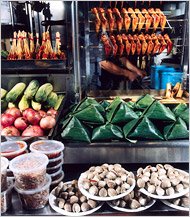
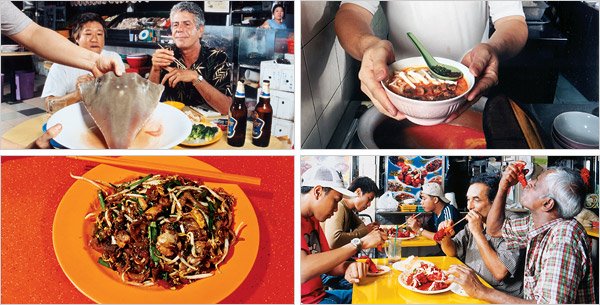
Pics: a selection of tidbits. Bourdain & Seetoh. Bowl of laksa. Plate of char kway teow. Eating sup tulang (specifically: trying to get at the marrow in the bones.
The Maxwell Road Food Centre dishes out all kinds of delicacies, like oyster pancakes and deep-fried fish meat soup as well as the Singaporean favorite, chicken rice.
There’s a fever-dream quality to Singapore, particularly if you’re a foodie. Outdoors, the heat is smothering. In the ubiquitous megamalls, the air-conditioning could frost a bottle of beer. Everyone, it seems, when not shopping for Prada or Armani, is feeding their faces. Yet unlike in other modern centers of conspicuous consumption, in Singapore, the local obsession with food focuses on “hawker stands” and “eating houses,” which are clustered in open-to-the-street food courts. They offer a nearly unlimited variety of Malaysian, Chinese and Indian mom-and-pop operations, each of them specializing in one or two dishes.
Centuries ago, when Chinese merchants immigrated south and were encouraged to intermarry — and when Indian entrepreneurs and planters joined the mix — a fantastic process of natural fusion began. Not the fusion of trendy restaurants of the West, where after a trip to Thailand a chef begins to toss around lemongrass with abandon, but a long, slow process of culinary mutation, born of people from three distinct cultures living and eating together. It is not unusual for a Singaporean or a Malaysian to grow up cooking three cuisines.
For budding gastro-tourists and first-time visitors to Asia, Singapore is the perfect city to avail oneself of a broad spectrum of culinary delights without straying too far from the familiar. English is an official language. Mass transit and taxis are cleaner and more efficient than in most places. Crime and annoyances are virtually, and rather notoriously, nonexistent. Even proficiency with chopsticks is unnecessary.
Hawker stands were once unregulated street vendors that sold dishes from carts, but some years back they were absorbed into official malls with electricity, running water and health-department-regulated work areas. There are about 115 of these centers throughout the city, each containing dozens of stalls, often separated by ethnicity. These gastronomic amusement parks are so popular that hotels like the Grand Hyatt have co-opted their simple, straightforward charms, and in some cases their chefs, and set up stands in their lobbies and dining areas. But for the real culinary delights of Singapore, you have to hit the streets.
On a recent trip back, and inspired by a previous culinary epiphany in Borneo, I hit Sungei Road Laksa my first morning in town. Once you’ve had laksa — a spicy Peranakan (Chinese/Malaysian) noodle soup — for breakfast, bacon and eggs become completely inadequate. It usually consists of seafood, rice noodles, fried bean curd, coconut milk and lots of chilies. The word “laksa” is said to have come from the Sanskrit word for “many,” referring to its many ingredients, but it might as well have referred to its many versions. The one at Sungei Road, though less fiery than the Borneo variety, is still a spicy hellbroth of fresh cockles, slices of fish cake and beehoon noodles in coconut milk, seasoned with garlic, red chilies, belacan (dried shrimp paste), lemongrass, galangal root and turmeric. It’s a classic “hurt so good” experience, requiring only a spoon — and a towel to mop the sweat from your face. For some time, I sat alone enjoying the sweet, relative coolness of the coconut milk against the sting of the chilies, with hearty bass notes of seafood and shrimp paste, while happily watching the morning commuters and fellow devotees slurping their breakfasts around me. Pure pleasure at around $2.
Since I have a passionate devotion to bone marrow, my next culinary destination was a foregone conclusion. (When asked my death-row meal of choice, my answer has always been a few lengths of roasted veal bone, with a slice or two of toasted baguette and some sea salt.) Seetoh’s guide pointed me to Haji Kadir-M. Baharudeen’s stand in the Golden Mile Food Centre as being the apex of sup tulang (bone soup), an Indian Muslim dish popular at the end of Ramadan fasting. For lunch, I found myself clumsily manhandling a sticky, slippery yet utterly wonderful heap of sauce-dripping bones, all the while wishing I’d wrapped myself in a dropcloth. The red mutton bones, stewed in a spicy sweet chili, tomato and mutton stock, arrived with a useless fork, a spoon, a little cabbage and some fried bread slices to mop up the sauce. The idea, apparently, was to pick up the bones with your fingers and tap them repeatedly until the buttery marrow slid out. Naturally, this didn’t happen. I tapped and banged in vain. I gnawed on the shreds of exterior meat. I dropped my bones, splattering myself, finally settling on spooning a little soup forlornly into my mouth. The proprietors, taking pity on the ang moh (foreigner — literally, “red head”), presented me with a straw, to the amusement of my fellow patrons. I jammed it in and sucked, striking the good stuff immediately. I came away with red-stained fingers, a ruined shirt and a feeling of happy, somewhat guilty stickiness.
While there is a real pride in the glorious mix of ethnicities here, there is also a fierce clinging to roots. My mentor Seetoh, for instance, never forgets that he is Chinese first. So when we eat together, it’s almost invariably at some new Chinese find that excites him. Tian Jin Hai Seafood in the Jackson Centre Kopitiam was his latest passion. We sat down at a sidewalk table in front of a long display counter with open crates of wriggling Sri Lankan and Australian crabs. We began with some freshly steamed gong-gong (whelks) and prawns. But we weren’t there for the famous chili crab or pepper crab, Seetoh explained.
Ten years ago the chef-proprietor of Tian Jin Hai had made a remarkable discovery. “Every day he goes to the fish market. And every day he sees shark,” Seetoh said. “For the Chinese, shark is very popular. But where are the heads? So he asks them: ‘You sell fins. You sell the meat. You sell the eggs. Where are the heads?”’ This simple question led, as so often happens in the annals of gastronomy, to discovery: that the typically discarded head of the reef shark, when steamed with ginger, red pepper and garlic and served with soy sauce and spring onions, is in fact a divine mosaic of tender, subtly flavored fat, skin and cartilage. Since introduced at Tian Jin Hai, what was once considered trash has become a rare treat.
Just as I’ve come to believe that in the heart of every great chef is a Chinese cook, I also believe that all great cuisines emanate from conditions of poverty, scarcity and difficulty. The best cooks, whether in Brazil or Thailand or France, for that matter, seem to come from those countries’ poorest regions, where cooks free of “the crippling handicap of affluence” (as A.J. Liebling put it) are compelled to make the most of things. Seetoh, unsurprisingly, shares this worldview. The next day, he took me out to a hawker center near the airport for a Chinese-based comfort-food classic: char kway teow (fried flat rice noodles).
Originally a poor-man’s lunch thrown together by fishermen, the dish has become a guilty pleasure for Singaporeans unafraid of its high-cholesterol charms. Hill Street Fried Kway Teow, Seetoh insisted, offered the best char kway teow in Singapore. A superior frying technique was of paramount importance — one must not burn the noodles. “Watch the master!” Seetoh urged, as an old gentleman tossed Chinese sausage, cockles, flat noodles and crispy pork cracklings into a sizzling wok and then poured in some dark soy. A minute or so before being unceremoniously dumped onto plates, a beaten egg was added, and it was still cooking when the steaming orders hit our table. It was an unlovely-looking brown heap, but I felt myself slowly seduced as I spooned on some chili sauce, my hangover from the previous evening’s festivities fading quickly. As with so much of the best of Asian cooking, this gooey mess was in fact a complex combination of distinct flavors and textures: sweet and savory, spicy and rich, gluey and crunchy. I needed a nap immediately after, but I went for tofu instead.
“Every time Michelle Yeoh comes to Singapore, she makes me take her here,” my friend the photographer Russel Wong said over a bowl of tofu fa, a hot bean-curd custard with sugar syrup that is chased with a glass of soy milk. It was late at night, and we were sitting at Rochor Original Bean Curd, a busy storefront. Frankly, I didn’t get it. Soy milk and tofu (unless it’s fried in animal fat) just don’t do it for me. But Wong, like a typical Singaporean, knows everything about food, and though I was not loving my tofu, I trusted that he could serve as my culinary Sherpa for tomorrow’s breakfast.
The next morning we went to Thasevi, an Indian spot featuring halal food located in a row of colonial-era “shop houses.” I sampled roti prata kosong (plain Indian flatbread) and roti prata telur (stuffed with egg). Wong also insisted that I try some chicken and mutton curries, which we washed down with teh tarik, or “pulled” tea, since alcohol is forbidden here. This Indian tea is brewed from leaves, dosed with condensed milk and then pulled, meaning poured back and forth between pitchers from increasing heights until it is frothy. After, Wong suggested that we meet the next day for the single dish most beloved in Singapore.
Ask any group of strangers here where to get the best chicken rice, and you will surely start an argument. If there is a national dish, it is this. An adaptation of a Chinese version from the island of Hainan, it’s deceptively simple looking, but locals passionately discuss the virtues and deficiencies of a particular rendition. Wong says the best version is at Tian Tian, in the Maxwell Road Food Centre. “It has to be a good chicken,” he explained as we sit down. “These come from Malaysia,” he continued, digging into a platter of plain-looking boiled chicken atop a heap of white rice. “The chicken must never be served hot.” It is boiled whole, on the bone, then (this is very important) dunked into ice water to separate the skin slightly from the meat. The chicken is then hacked into pieces and served on boiled rice. Chicken broth, chili sauce, pounded ginger purée and dark soy sauce are served in separate bowls on the side. You eat the dish with a fork and a spoon. To an aficionado, chicken rice is a dish with infinite possibilities. Drizzle the soy in a thin stream over it, or not. Dip each bite in broth, then brush lightly with chili sauce or soy, or dip in garlic, or all of the above. Or simply add all the condiments at once and mash the whole business together. As we were eating from the same platter, Wong and I dipped in sequence. It is a light and beautiful thing, chicken rice. Part comfort food, part Zen ritual, yet finally just a darned good lunch.
And as I sat there, gazing at stalls with signs promising Big Scissors Curry Rice, Foo Zhou Oyster Cakes, Kway Chap Seafood Soup, Zhen Zhen Porridge, Fresh Prawn Won Ton and Fish Ball Noodle, I felt as if I were inside an edible pinball machine, one in which I could happily career forever. But not today. I had one more meal in Singapore.
Chicken rice may serve as the national dish, but bak kut teh, literally pork-rib tea, was a dish about which I was constantly nagged. That I had yet to try it had long since become an embarrassment to my friends, who were well aware of my predilection for all things porcine. This time, I was not leaving without putting this important notch on my gastronomic belt. I consulted Seetoh’s guide and headed out to Rong Chen. The stand is made up of a few tables on a concrete porch on the Sin Ming Road. I had just sat down when a group of businessmen invited me to join them at a nearby table. I had intended to eat my last meal in Singapore alone, but the sight of a lone ang moh, struggling to understand the handwritten signs, and the possibility that I might fail to fully appreciate what I was about to eat, was apparently too much for them.
Bak kut teh is essentially a heap of pork, usually ribs, cooked in broth. Said to have been created as food for Chinese laborers in early-20th-century Malaysia, it has become a beloved ritual for Chinese businessmen, a weekly or even daily combination of working lunch, social gathering and lengthy discussion of its many versions. “I don’t play golf,” one man announced proudly. “I eat bak kut teh. Every day. Sometimes twice a day.” He and his friends meet at a revolving number of places serving the dish and spend hours doing pretty much what they were doing at that moment: eating, drinking tea, talking business, welcoming friends and pausing now and then to chatter into cellphones. After introductions, my new friend explained that Rong Chen serves a “white version” of bak kut — basic pork ribs and broth, flavored with pepper (as opposed to herbs) and whole cloves of garlic, the pork free of the darkening effects of soy. The herbal (darker, usually soy-infused) dish tends to be more tender, he said. After a few cups of tea, some salted vegetables and fried bread came the main event: huge, steaming bowls of meaty pork ribs in a translucent broth. Chili dipping sauce was served on the side. As we gnawed on bones, tearing off peppery strips and drinking spoonfuls of the cooking liquid, our waiter continued to replenish our broth.
So it was another day in foodie paradise. And that is Singapore’s singular danger. It is easy to get sucked in, to get used to the little things on your daily table — the tiny dishes of sambal or chopped red chili peppers, the soy sauce, even the moist towelettes. You begin quickly to expect them, to take them for granted. And once you get used to the sights, sounds, smells and tastes, there is no going back. Western food becomes eerily bland and flat. You find your soul kidnapped by the memory of condiments. And, of course, of the people who introduced you to them. If you like the idea of getting lost in Asia, Singapore is the perfect place to start.
Essentials: Singapore
HOTELS
The city has no shortage of well-established — and uniformly excellent — five-star properties, including the Four Seasons Hotel (http://www.fourseasons.com/), Grand Hyatt (http://www.hyattcom/), the Oriental (http://www.mandarinoriental.com/), Raffles Hotel (http://www.raffleshotel.com/), the Ritz-Carlton Millenia (http://www.ritzcarlton.com/) and Shangri-La Hotel (http://www.shangri-la.com/). There are also a handful of stylish (and sometimes less expensive) newcomers, among them the Fullerton Hotel (http://www.fullertonhotel.com/), Hotel 1929 (http://www.hotel1929.com/) and New Majestic Hotel (http://www.newmajestichotel.com/).
RESTAURANTS
The Makansutra Singapore food guide is the bible for eating in Singapore; you can find it in bookstores all over the city. At nearly all of the following food stands and “hawker centers,” two people can have a meal, including drinks, for less than $12; most do not have phones. Haji Kadir-M. Baharudeen Golden Mile Food Centre 505 Beach Road No. B 1-15. Hill Street Fried Kway Teow Blk 16 Bedok South Road No. 01-187. Thasevi 237/239 Jalan Kayu. Rochor Original Bean Curd 2 Short Street. Rong Chen Bak Kut Teh Blk 22 Sin Ming Road. Sungei Road Laksa Blk 31, Kelantan Lane No. 01-12. Tian Jin Hai Seafood Jackson Centre Kopitiam 39 MacPherson Road, Stall 13. Tian Tian Hainanese Chicken Rice Maxwell Road Food Centre, Stall 10.
Friday, November 25, 2005
S'pore served with top prize in food Olympics
FROM chicken rice paradise, to land of world-class chefs. Singapore has made its mark in the food world - and that is official.
The Singapore national culinary team out-cooked nine other countries to become Culinary World Masters at the Salon Culinaire Mondial, the food Olympics, on Wednesday.
This competition is held every six years.
The event, which took place in Basel, Switzerland, this year, began last Saturday and ended after five days. It is one of six global competitions accredited by the World Association of Cooks' Societies.
Only 10 of the world's top teams are invited to compete for the Culinary World Masters title.
Singapore's seven-member team comprised award-winning chefs from establishments ranging from Swissotel The Stamford to Mount Elizabeth Hospital.
Singapore beat giants Canada and Switzerland in the overall rankings, also winning a gold medal in the cold food category, which involved creating food displays based on innovative themes, and a silver in the warm food category, where each national team had to create a three-course menu for 110 people.
The win puts Singapore at the forefront of the food industry, said Singapore Chefs Association vice-president Angelo Sanelli.
'Some people just see Singapore as hawker centres and nothing else, but we competed against seasoned champions in Europe and won,' said Mr Sanelli.
'We're setting the trend now,' he added.
The Singapore team will return on Sunday morning at 7am on flight SQ 346, and members of the public are invited to welcome them home.
Hail to the chefs: Mr Edward Voon, The Oriental Singapore; Ms Jasmine Ng, Tourism Academy@Sentosa; Mr Ivan Yeo, Equinox Complex; Ms Nicole Wong, Swissotel The Stamford; Mr Yen Koh, Givaudan; Mr Ron Ng Choon Kiat, Equinox Complex; and Mr Tan Lai Hong, Mount Elizabeth Hospital.
from The Straits Times Interactive
Nov 25, 2005
Friday, November 04, 2005
MUST READ - S'pore-Malaysia ties: When words get in the way
MALAYSIANS who find Singapore largely congenial and who have settled here - I'm talking about myself, yes, but also half a dozen others whose names I'd happily reveal if subpoenaed - find the whole subject of Singapore-Malaysia relations enormously tiresome when it comes up, say, at dinner parties.
My usual response is subtle.
In the manner of Roger Moore, I have become adept at communicating turbulent, complex emotions with my eyebrows: a mixture of melancholy, cunning, boredom, and that sensation of wanting to abandon one's espresso and flee.
Sometimes, this is sufficiently eloquent to get the subject changed to something less controversial, such as the Question of Palestine, or the nature of God, but sometimes, as my wife is fond of reminding me, eyebrows just aren't enough.
Actual speech must begin at this point, and therein, I submit, lies the whole problem.
My pet theory on Cross-Straits Tensions, which I will now divulge without my usual recompense of a bourgeois dinner, is that while the actual issues are no doubt inherently complex, things are made additionally irksome because the leaders of Singapore and Malaysia use language in very different ways, and each party finds the other's style alien and offensive.
(Before I continue, possibly invoking the wrath of various important people who have proper jobs, I should admit that I'm merely a playwright, and therefore have as much credibility in an Asian society as, say, a scoop of washing powder, or a sleeping dog. I do, however, spend a lot of time making mental notes on how people speak so that I can reproduce it in a play and earn a living thereby, so I'm not wholly unqualified to talk about this.)
Simply put, the problem is that Malaysian political speech is hardly ever straightforward and often playful, while Singaporean political speech is always direct and hardly ever ironic.
Even when they're all speaking English, they're effectively speaking different languages.
In Kuala Lumpur, someone reading or hearing an utterance of any sort by a Malaysian politician automatically and subconsciously adjusts it for context to arrive at its real significance. Nothing is assumed to mean exactly what it says.
To wit: If something were said while addressing an annual party conference, it would sound more ethnically chauvinist than the speaker might really be; if it were said in response to a question by a foreign journalist, it would sound more belligerent than the speaker actually feels; if it were said to a local journalist, it would sound more confident than circumstances might warrant.
If something is flatly denied, it's probably at least partially true, and everyone understands both that it's true and that it's necessary to deny it.
If an accusation isn't addressed at all, it's probably false, but is occasionally true. If an accusation is met with the threat of legal action, it's probably true, but is occasionally false.
A comment about religion is almost always understood to be about secular power struggles.
A seemingly irresponsible and outrageous remark is generally accepted as the product of a sardonic sense of humour that doesn't come across in print.
Delivery and tone of voice are so important: a gentle lilt leading up to the sting; a slow, damning drawl; a razor-sharp quip.
On certain occasions, of course, an irresponsible and outrageous remark can indicate a lack of preparedness, or, if it was said between 4 and 5pm, a low blood-sugar level on the part of the speaker. These things are understood.
Language in Malaysian political culture is a joyful, vibrant, colourful thing. The most inflammatory assertions and the most flamboyant metaphors are reserved for opponents and issues of consequence; if something is dealt with simply and directly, it can't be of any importance.
In short, a Malaysian listening to a Malaysian political figure - whether from the government or the opposition - knows instinctively to compensate for the hyperbole, to pay attention to understatement, to grasp the indirect reference, to discount the obviously rhetorical, and to revel in the ironies.
Malaysians simply do not take each other literally, and do not expect to be taken literally. Indeed, taking things too literally is a social gaffe: If inadvertent, it reveals a lack of sophistication; if deliberate, a lack of manners.
In Singapore, however, ambiguity and rhetorical flights of fancy have no place. The culture of official communication values precision, directness and economical delivery. So ministerial statements are always measured, unflashy, thought through; can you think of one that hasn't been?
Bombast is absent, as are whimsy and repartee. Everyone's been briefed; off-the-cuff remarks emerge in complete paragraphs.
Even the jokes of Singapore ministers are always carefully signalled as such in press reports, lest there be misunderstanding. Clarity is key; oratorical flourishes are suspect.
Singaporeans expect to be taken at face value, and in return, they take others at face value; they cannot conceive of having to not take someone at face value in order to communicate effectively.
Looking back at the past decade or so, it seems to me that when the important people of the two countries have talked about important things, a tragic disconnect has sometimes occurred.
In the most extreme, unfortunate cases, substantive disagreements have been needlessly worsened because Singaporeans have taken Malaysian statements as evidence of aggression, irrationality, and mendacity, while Malaysians have unfairly interpreted Singaporean speech as inflexibility, belligerence, and gracelessness.
All that's past, we're told. Relations, they say, have hit a new high, and everyone's talking again. But unless we learn to celebrate our different ways of speaking, by listening carefully and trying to interpret things the way another person from the speaker's country would, talking might turn out to be less of a solution than a problem.
And for those of us who have a deep affection for both nations, we would have to remain in strained silence, refusing to comment, distress written all over our eyebrows, plain for all to see.
Huzir Sulaiman
Playwright Huzir Sulaiman is a joint artistic director of Checkpoint Theatre and is the 2005 National University of Singapore-Faculty of Arts and Social Sciences/ The Arts House Writing Fellow. A collection of his work, Eight Plays, is published by Silverfish Books.
A MATTER OF STYLE
Malaysians simply do not take each other literally, and do not expect to be taken literally. Indeed, taking things too literally is a social gaffe: If inadvertent, it reveals a lack of sophistication; if deliberate, a lack of manners. In Singapore, however, ambiguity and rhetorical flights of fancy have no place. The culture of official communication values precision, directness and economical delivery.
Sunday, October 30, 2005
Teen poet wins 2nd global prize
Amanda Chong's piece on starving kids wins top British award; she clinched Commonwealth essay prize last year
MOST of us have heard this meal-time mantra: 'Finish your food. Children are starving in Africa.' But Amanda Chong, 16, not only finished her food, she also wrote an award-winning poem about the hungry children as well.
She is one of 15 winners and the only one from Asia to win this year's Foyle Young Poets of the Year Award, Britain's most prestigious poetry prize for young writers between the ages of 11 and 17.
The winners were chosen from almost 6,000 entries worldwide.
'The awards ceremony was great because I got to meet the other winners from different parts of the world and many of them like the same poets as I do,' said Amanda, of the Oct 9 event in London.
Winning international awards is not new to the Secondary 4 student of Raffles Girls' School.
Last year, she won the annual Commonwealth Essay Competition with a short story: What The Modern Woman Wants. It focused on the conflict in values between an old woman and her independent-minded daughter.
Her poem, How To Watch A Child Die, is about 'our apathy towards global problems, and the strange ability of people in developed countries (like ours), to dismiss these issues after a cursory glance', she told The Sunday Times.
Poet George Szirtes, one of the two judges in this year's competition, said Amanda's poem was picked because 'it seemed to us a passionate, yet controlled, precise and impressively mature work.' He added: 'A point of view, however sympathetic, does not constitute a poem. Language does, and here, we felt, language, music, intelligence and feeling had come together most productively.'
The poem was partially inspired by pictures of hungry children in Africa as well as a school trip to Britain and France, where Amanda learnt about the Industrial Revolution.
'There was a strong sense of apathy during the Industrial Revolution towards child labour and that sort of apathy remains till today,' she said.
Human rights, fair trade and the environment are among Amanda's pet causes. Her interest in world issues and her love for reading and writing were nurtured at a young age by her lawyer father. 'My dad would tell us stories. He would also summarise world events for us so we knew what was going on,' said the second of four children.
'I started writing fantasy stories at age six, before I could even spell properly,' she added. Her favourite authors and poets include Victor Hugo, T.S. Eliot, Sylvia Plath and Ted Hughes.
Her mother, housewife Alison Chong, 44, admits some of her daughter's poetry are, on the first reading, Greek to her. 'If I ask her what she means, she rolls her eyes,' said Mrs Chong.
Her English and literature teacher, Miss Ng Siew Luan, 30, said: 'She's very socially aware and her simple style belies a deeper message that is able to strike at the heart of her readers.'
As for her future, Amanda wants to read law at Oxford or Cambridge University in England. 'I want to work with an international organisation like the United Nations. Hopefully, through policy-making, I can help make a difference.'
HOW TO WATCH A CHILD DIE
- By Amanda Chong
Avert your gaze from his eyes,
even if they plead for you to be drawn to their depths.
Instead focus on his sallow complexion the sun crawling on his aged skin,
the colour of the well-trodden carpet in your living room;
the spot where your son once threw his football boots
and you missed bleachingfor the past few years.
Do not try to guess his age
or say he is older than he looks as you study his brittle bones,
too-large headand the empty basket of his ribcage.
Think instead of the sound they may make when his body is thrown into a ditch;
the sound of rain whipping through branches, the crackling of a creek before thaw
or your antique vase crashing into smithereens from its place on the mantelpiece.
Turn away from the blank faces of your own children
and make no associations.
Pretend you do not notice how your teenager leaves her food uneaten on her plate.
(Convince yourself you are not an escapist) After all,
this skeletal child is merely a marionette in a macabre fairytale.
Now, ignore the queasy feeling in your stomach
as you get up to dish out the dessert.
Resolve to write to the authorities to complain
for showing such disturbing footage during dinner.
Be blind to the broken birds of the child's hands as they reach out pleading to be held,
the rolling whites of his eyes, the bruised animals of his lips, parting, as he takes his last...
Turn off the television set.
Children should not know that (in some very remote parts of the world)
they may die before their mothers.
Melissa Sim
The Sunday Times @ The Straits Times Interactive, 30 October 2005
Tuesday, October 25, 2005
Keystone Symposia - World's top scientists meeting here
ONE of the world's most prestigious scientific meetings has landed on Singapore shores, the first time it is being held outside the United States. LEADING LIGHTS: Experts, such as Dr Irving Weissman and Dr Suzanne Cory, are here for the prestigious Keystone Symposia, held for the first time outside the US.
Starting today, the five-day Keystone Symposia features international big names in stem cell and cancer research. About 500 scientists and doctors from the US, Europe and Asia are here to exchange ideas and network with the best in the field.
With experts such as Dr Irving Weissman, director of the Institute for Cancer/Stem Cell Biology and Medicine at the Stanford University School of Medicine, and Dr Suzanne Cory, director of The Walter and Eliza Hall Institute of Medical Research, it had scientists the world over scrambling to attend. In fact, organisers had to turn down about 200 hopefuls.
The goal of the meeting is to explore the links between stem cell biology, ageing and cancer.
Stem cells can reproduce indefinitely and can potentially turn into very different tissues.
Interestingly, cancer cells have been found to resemble stem cells, with their indefinite growth and very primitive appearance. But while stem cells are highly organised and controlled, their cancerous counterparts are chaotic and in total disarray. So the idea is that if researchers can learn to control the inner workings of stem cells, they could in turn reverse the process in cancer cells and devise better treatments for cancer.
That the prestigious conference is being held here is a sign that Singapore - with its focus on both cancer and stem cell research - has achieved a significant level of international recognition.
Keystone Symposia CEO James Aiken said: 'Singapore has distinguished itself as an international biomedical hub.'
Some of the biggest corporate names and individual stars in biomedical science are here, he said, and high quality scientific manpower is complemented by state-of-the-art research facilities, good funding and a strong regulatory infrastructure.
Explaining the decision to move the conference here, he added: 'This steadfast commitment and international appeal makes Singapore an obvious choice.'
The executive director of the Genome Institute of Singapore (GIS) and one of the meeting's co-organisers, Professor Edison Liu, said: 'Having the meeting here means a lot on the international scale; it means that we have arrived at a certain level of credibility.'
Progress in the field is still incremental, he cautioned, and it would still be years before stem cells would be used to treat cancer in the clinical setting.
The conference, apart from being a melting pot of ideas, would also be a good chance to highlight Singaporean science to the international community, he added.
One of the speakers who will highlight work being done here is Dr Lena Motoda, who is doing her PhD at the Institute of Molecular and Cell Biology. Her research involves studying the relationship between leukaemia and stem cells.
Dr Ng Huck Hui of GIS will describe his work on mapping the control network of the master switches that maintain stem cell characteristics.
All in all, a good showing for Singapore.
On the international front are people like Dr Elizabeth Blackburn, a leader in the area of telomeres - the structures at the ends of chromosomes, and telomerase - an enzyme which prevents chromosomal fraying. Telomerases are essential for stem cell function and also important in maintaining the cancer state.
A professor at the University of California, San Francisco, her latest work has uncovered new findings about how telomerase is giving cancer cells stem-cell-like properties, and how this could lead to better targets in the fight against cancer.
Chang Ai-Lien
The Straits Times Interactive, 25 October 2005
Monday, October 17, 2005
Singapore team produces early alert cancer test
Breakthrough kit warns of disease years before tumour appears
A RESEARCH team here has developed a new, accurate cancer test kit, which can give warning signs of the disease years before the first physical signs appear by detecting minute chemical changes in a patient's DNA.
The Institute of Molecular and Cell Biology (IMCB) team, which counts top-notch Japanese cancer researcher Professor Yoshiaki Ito as its adviser, has been working with electronics giant Hitachi on the joint project since April last year.Hitachi is working with the team to take the kit to the marketplace, to grab a slice of the growing cancer diagnostics market, valued at S$110 million this year and which is projected to rise to S$185 million by 2008.
Their kit works by looking at minute changes in the chemical letters, A T C and G, that make up DNA. In some cancers, C - which refers to the chemical cytosine - undergoes a chemical change that alters its molecular structure.
Scientists are not quite sure why this happens, but believe lifestyle and environmental factors could trigger it.
Normally, DNA is fairly resilient: genes control and regulate the expression of proteins and the body is able to suppress the dangerous genetic changes which can lead to cancer. But, in some cancer cases, when cytosine undergoes the specific chemical change - methylation - the controller genes lose the ability to produce the correct proteins to prevent tumours.
Lead researcher Masafumi Inoue explained: 'Think of it as shutting down your body's innate surveillance system.'
'There is no more controlling influence. It is not only one gene, but several genes which are silenced when this change occurs.'
Gastric cancer, for one, is heavily correlated with DNA methylation, he said. And the molecular changes happen years before any physical symptoms appear.
The conventional method of screening for DNA methylation is laborious, examines only few genes at a time, and can be inaccurate. So, together with Hitachi, the IMCB team has devised a test kit which examines multiple areas, or targets, at one go.
The breakthrough test kit is not the only reason to cheer for IMCB. Its head, cancer research trailblazer Sir David Lane, has won a prestigious international award. The Sergio Lombroso prize, awarded once every two years, went to the scientist known worldwide for his role in discovering the p53 gene three decades ago.
Another leading cancer scientist here, Professor Axel Ullrich, who heads Singapore's Onco Genome Laboratory, has also been lauded. He has been given the University of Southern California Marshall School of Business European BioBusiness Leadership Award, for developing cutting-edge therapies for diabetes and breast cancer.
Natalie Soh
The Straits Times Interactive, 17 October 2005
Why the casino will always win
Casinos exist to make profits, they do so from patrons who place bets on various games that are offered. Yet many casino patrons are relatively uninformed about the games they are playing.
When you go to a cinema, you know how much you pay for your entertainment. When you go to a casino, you do not know how much you will win or lose - it will depend on the spin of a wheel, the turn of a card.
But you should expect to lose, and you should know how much to expect to lose, because this information is available through a quantity known as the house margin or house edge.
Every bet made at the casino has a house margin. Suppose the house margin for a particular bet is 2 per cent. This means that if you place this bet many times, you will lose about 2 per cent of the total amount of money you wagered.
For a more concrete example, suppose a friend offers you the following $1 bet on the toss of a coin. If the coin lands on heads you lose your $1. If the coin lands on tails you get back your original $1 wager and receive $0.50 profit. Assuming the coin is fair, so that both heads and tails are equally likely, the house margin for this bet is 25 per cent. If you play this game 100 times, your total wager is $100, and you can anticipate losing about $25. The actual amount you lose may be greater or less than $25 depending on how the coin falls.
Suppose now that your friend offers you a different bet: You still lose if the coin lands heads, but if the coin lands on tails you now get a profit of $0.98. The house margin for this bet is 1 per cent. If you play this game 100 times, you can anticipate losing about $1, though again the actual amount you lose may be greater or less than $1. If you are lucky you may see a profit, but this becomes less likely the more you play.
The two bets outlined lead to the observation that, in percentage terms, you can anticipate paying less money at the casino if you place bets with lower house margins. Lower house margins are to your advantage; they will cost you less because you can anticipate a higher proportion of your total wager being returned. For the same level of entertainment, a lower house margin provides a better deal for patrons.
Let's consider the house margins for roulette, Sic Bo (Tai Sai), baccarat, craps and blackjack.
Roulette
THE roulette wheels typically used in Europe and Australia have 37 slots or pockets. A ball is spun into the wheel and comes to rest in one of the slots. Bets can be placed based on the outcome of the spin. We assume here that the roulette wheel is fair and the ball is equally likely to land in any of the 37 slots.
The wheel has 18 red slots and 18 black slots. The remaining slot, denoted by the numeral 0, is typically coloured green. Consider betting $1 on the outcome that the ball lands in a red slot. If this occurs, your bet wins, and the casino pays you even money, which means that you get $2; your $1 wager and $1 profit. On the other hand, if the ball lands in a black or green slot, you lose your $1 wager. The green slot gives the casino the advantage, because the ball will more likely land in one of the 19 black/green slots than in one of the 18 red slots. This gives the casino a house margin of 2.70 per cent. If you make this bet 100 times, you can expect the cost of playing to be $2.70, though the actual amount that you lose may be greater or less than $2.70.
The money that the casino pays out on winning roulette bets is calculated so that whatever bet you make, the house margin is always 2.70 per cent. If you spend a long time at the roulette table, expect it to cost you 2.70 per cent of the total amount of money you wager. An American roulette wheel has an additional slot denoted by 00. This additional slot favours the casino; the house margin for American roulette is 5.26 per cent.
Sic Bo
Sic Bo is a dice game which is also known by the names 'Tai Sai' or 'Big and Small'. Different bets can be placed based on the values obtained by three dice. Unlike roulette, different bets give different house margins. The bet known as 'Big' wins if the sum of the three dice is 11 or greater, with the exception that the bet loses if the three dice all show the same number. The exception gives the casino the advantage. For a winning bet on 'Big' the casino pays you even money. Without the exception, losing or winning the bet would be equally likely. With the exception, a loss is more likely than a win. The house margin for the bet 'Big' is 2.78 per cent.
The bet known as 'Small' is a bet on the sum of the three dice being 10 or less, again with the exception that the bet loses if the three dice all show the same number. The house margin is again 2.78 per cent.
Another possibility is to place a bet on all three dice being equal to six. On average this will happen only once in every 216 occasions. For a $1 wager, a winning bet on this very unlikely event means that the casino gives you $180 profit, resulting in an unfavourable house margin of 16.20 per cent. Some casinos give you only $150 profit, which results in a hugely unfavourable house margin of 30.09 per cent.
The house margins of 2.78 and 16.20 per cent are typically the lowest and highest house margins of all bets that can be made at the game of Sic Bo. This means that if you spend a long time playing Sic Bo, expect it to cost you between 2.78 and 16.20 per cent of the total amount of money you wager, with the precise percentage depending on the type of bets that you make.
Baccarat
Baccarat is a card game where the 'player' plays against the 'banker'. Neither the player nor banker makes any decision that influences the outcome of the game, which is completely determined by the order of the cards.
There are three outcomes: a player win, a banker win or a tie. A version of the game known as mini-baccarat has the same rules, payouts and house margins. The only difference is that mini-baccarat is typically faster, and therefore more bets are made in any given period.
You may bet on the banker to win the card game. If the player then wins the card game, you lose the bet. If there is a tie the wager is returned to you. Similarly, if you make a bet on the player, the bet loses if the banker wins, and the wager is returned if there is a tie. A $1 winning bet on the player pays even money and therefore gives you a $1 profit, whereas a $1 winning bet on the banker typically gives you a $0.95 profit. Usually the game is played with eight decks of cards, in which case the house margins immediately after a card shuffle are 1.06 per cent for betting on the banker and 1.24 per cent for betting on the player. You may also be able to bet on a tie, but this bet is unfavourable and is best avoided.
In a series of games the house margins may be slightly different, but these values are an accurate approximation, assuming that you do not keep track of the cards that have been dealt in previous rounds of play.
A skilled player may use this information to decrease the house margins, but only by small amounts.
Some casinos also offer a variation of the game where a winning $1 bet on the banker pays a $1 profit unless the banker's winning hand has a value of six, in which case you get a $0.50 profit. Under this variation, the house margin for betting on the banker increases to 1.46 per cent.
Craps
Craps is a dice game where each round consists of rolling two dice one or more times. The dice are rolled by casino patrons, and the value of the roll is the sum of the two dice. There are numerous possible bets that can be placed, and they have different house margins. I will consider one popular bet which is synonymous with the game of craps.
The first roll in each round is known as the come out roll. If the come out roll is 7 or 11, the bet wins. If the come out roll is 2, 3 or 12, the bet loses. If any other number is rolled, this number is known as the point. The two dice are then rolled until either the point or a seven is rolled; in the former case the bet wins, while in the latter case the bet loses. A winning bet pays even money. The casino again gets the advantage because a loss is more likely than a win. The house margin for this bet is 1.41 per cent.
Assumptions
A question that is often asked is whether the house margins for these games can be altered. The calculation of the house margins are based on mathematical results that cannot be challenged.
However, the calculations are also based on assumptions about the game and these assumptions can be challenged. For example, in Sic Bo, one assumption is that all three dice are fair, so that each of the six numbers on each die are equally likely to appear. If the dice were unfair, then the house margin would not be as given here. It seems reasonable to assume that the dice in Sic Bo are fair.
Suppose that you play one of the four games described above and you accept that the assumptions on which these house margins are based are reasonable. The assumptions include fair die rolls, well-shuffled cards and fair roulette wheels. These house margins are then fixed. Whatever choices you make, you cannot change these house margins and you cannot make any decisions which will affect them.
However, there are casino games for which you can affect the house margins. One of the most popular is blackjack.
Blackjack is very different to any of the games above, because you have to make decisions during the game, and the decisions you make can affect whether you win or lose. To analyse such games, we need to know in advance what the player intends to do. Suppose that before the game begins, the player decides on exactly what decisions he or she will make under any given circumstances. This set of decisions is known as the player strategy. Once the player strategy is known, the house margin can be approximated.
Assuming that the player does not keep track of the cards that have been dealt in previous rounds, the strategy that achieves the minimum house margin is known as the Basic Strategy. The game of blackjack has many different variations in the rules implemented by different casinos, and the Basic Strategy depends on the exact rules that are implemented. Moreover, the different rules mean that different house margins can be obtained at different casinos.
For most casinos, the house margins that can be obtained under the Basic Strategy are between 0.4 and 0.6 per cent. But these house margins can only be obtained if the player makes no errors in playing the Basic Strategy. In practice, errors may be made and the house margins will then be larger.
While the house margin gives you valuable information about the bet you are making, it does not tell you everything. For example, placing 100 $1 bets on red at a roulette table is not the same as placing 10 $10 bets on red, and yet in both cases we have the same house margin, at 2.70 per cent, and the total wager is the same.
For both of these scenarios, you expect to lose 2.70 per cent of $100, or $2.70, though the amount you actually lose may be greater or less than $2.70.
The difference lies in the statistical concept of variation. For 100 $1 bets, the amount you actually lose will typically be closer to $2.70 than for 10 $10 bets because there is less variation, and therefore less risk involved.
The house margins tell you how much money you can expect to lose.
It is easy to forget that casino house margins are percentages, and this has an important consequence: The more money you gamble, the more money you can expect to lose.
Alec Stephenson
for The Straits Times Interactive, 17 October 2005
The writer is an assistant professor of statistics at the National University of Singapore.
Sunday, October 09, 2005
Nurturing science, Singapore-style
When some of the world's top scientists and policy-makers met in Kyoto recently, they gave Singapore high marks for creating a science-friendly environment that makes cutting-edge research possible.
TIRED and battle-weary, Japanese Prime Minister Junichiro Koizumi no doubt felt butterflies in his stomach as the final votes of the country's snap elections were counted out on Sept 11. Yet, poised as he was on the precipice of his career, he chose to spend those critical hours in the company of Nobel laureates, top scientists, policy-makers and opinion leaders from all over the world.
They were there for the second annual Science and Technology in Society forum at the invitation of Japan's former science and technology minister Koji Omi, a member of its House of Representatives.
Held in Kyoto, the forum has been called the scientific equivalent of Davos, the think-tank session of world leaders held annually in Switzerland.
The goal was to discuss the challenges facing mankind, and to explore the proper application of science and technology to address them. The aim - to ensure the survival of the human race.
'These issues have a global reach and cannot be solved by a single country,' Mr Koizumi told the 500-strong audience of scientists and policy-makers from over 60 countries. His words resonated with many.
Singapore a model
WHILE there was consensus on the key problems - such as the need for renewable energy sources, common international rules for bioethics, universal access to education and a global system for intellectual property rights - agreement on the best solutions was more elusive.
The concern was whether governments would be able to execute such large-scale plans. Would there be political will, scientific leadership and societal acceptance of the costs?
This was when another observation became progressively apparent: tiny Singapore was becoming a model for how science can provide solutions for problems confronting society.
Genome Institute of Singapore head Edison Liu told The Sunday Times: 'I truly believe that science and technology, if managed carefully, are the only solution to the problems of human expansion in the world.
'And Singapore is an example of how to do this, both for developing and developed countries.'
Professor Liu, an American, was director of the Division of Clinical Sciences at the US National Cancer Institute before he joined Singapore's biomedical efforts.
Take the example of infectious diseases that recognise no borders. While many countries are still grappling with how to combat the bird flu outbreaks threatening to turn into the next flu pandemic, Singapore already has detailed action plans in place, ranging from stockpiling drugs to being on standby to cull all fowl here.
It is also a regional leader in bird flu research, with companies and research institutes working to produce effective vaccines and diagnostic kits, to shore up defences against the disease.
Prof Liu was part of a Singapore contingent which included Professor John Wong, vice-president of research and life sciences at the National University of Singapore, Japanese-born cancer specialist Yoshiaki Ito of the Institute of Molecular and Cell Biology, and Singapore's biomedical sciences architect Philip Yeo.
No doubt, scientific efforts here are very young, and only time will tell if they will bear fruit. But the foundations - fair, transparent regulations, solid research infrastructure and an increasing pool of human talent - are being laid.
Delegates from larger nations noted the Singaporean signature of speed and efficiency with which it has addressed some of the problems being discussed. For example, the Republic was highlighted for its science-friendly stem cell regulations.
Embryonic stem cells show such promise because they can transform into any cell that an ailing body needs, and could potentially cure a host of debilitating diseases, such as Parkinson's, Alzheimer's and cancer.
Emerging contenders
SINGAPORE and South Korea were touted as emerging contenders in such research, gaining a foothold in an area where traditional leaders such as the United States have fallen behind because of prohibitive restrictions.
Some openly marvelled at how life sciences had emerged with a flourish over the last few years.
'I believe biotechnology in Singapore is the centre of such research in Asia,' said Mr Omi, the forum's organiser. 'I have been very impressed with all that has been done.'
Mr Omi acted on his compliments: he recruited Mr Yeo to be a founding member of the forum, and was the championing force in Japan behind Singapore's most ambitious research tie-up yet - an extensive agreement between the Agency for Science, Technology and Research (A*Star) and Japanese scientific giant Riken, with possible collaborations to develop anti-cancer drugs and cultivate screening methods and rapid diagnosis for infectious diseases.
Mr Yeo, A*Star's chairman, was a prominent figure at the Kyoto event. And at a plenary session he chaired, he was characteristically forthright when he declared that the most important assets were human.
'The key limiting factor to continued economic growth for all modern nations will be the availability of highly educated and trained science and technology human capital,' he said.
Finding the right human talent has been his preoccupation, and as bright young Singaporeans are being trained, the foreign stars of the scientific community here have made all the difference.
There is a reason why the same names currently representing science here are heard again and again. They have made it internationally, and they are now trying to help Singapore pull ahead.
Professor Yoshiyuki Sakaki, director of Riken's Genomic Sciences Centre, said that Singapore was brought to his attention when Prof Ito, one of Japan's top cancer researchers, moved here from the University of Kyoto with his research team three years ago. 'That was when a lot of us first recognised what was going on in Singapore,' he said.
He continued with the accolades by highlighting an ambitious initiative started 'under the great leadership' of Prof Liu last year, which has brought together hundreds of Asian scientists to paint a detailed genetic picture of Asia.
They hope that this collective effort to map out the genetic variations between races can form the basis for future studies seeking to understand why some people are more prone to diseases.
The Asian-centric nature of this initiative is novel. This project 'is going well, and it is a great model of how Asian scientists can collaborate', said Prof Sakaki.
There are also increasing signs that the Republic is gaining clout in this global scientific brotherhood. The Genome Institute of Singapore, for example, has already garnered more than $9 million in funding from international sources, including the US National Institutes of Health - well-known for its rigorous funding criteria.
Mr Yeo described one key strategy in attracting and retaining such talent: through 'the investment in physical infrastructure and establishing a total environment that is conducive to intellectual pursuits, and that is attractive and appealing'.
He has led the creation of the Biopolis, the $500 million complex in Buona Vista for biomedical research. Then there is the future Fusionpolis in Ayer Rajah, the multi-million-dollar complex that will house infocommunications and media research. Each was designed to encourage interdisciplinary and integrated research.
Indeed, he has done so much for local science and technology efforts that one scientist, on spotting him at the forum, jokingly referred to him as the 'secret leader of Singapore'.
And despite occasional controversies, the record is impressive. According to last year's National R&D Survey, there are 765 companies involved in research and development in Singapore, and more than $15 billion in revenue was reported from sales of their products or licensing of new technologies last year.
Output doubles
BIOMEDICAL manufacturing output has also doubled in just four years so that the 2005 target of $12 billion was surpassed last year, a year ahead of schedule.
Employment in biomedical manufacturing and R&D is booming, with 9,000 people employed in the industry last year, a figure which the Economic Development Board hopes to grow to 15,000 by 2015.
About two in three researchers in A*Star's public institutions are foreigners.
Since 1991, the Government has committed $12 billion to science and technology, over three five-year plans. But recognising the importance of putting more resources into shaping the economy through R&D, it will commit that figure over the next five years alone.
The Kyoto forum was a good place for Singapore to assess the plans of other nations.
Said the ever-practical Mr Yeo: 'We are the youngest member compared to other countries, and we are here to learn from the senior people.'
Having said that, it was as likely that other countries also learnt from Singapore.
Chang Ai-Lien
Think, The Sunday Times @ The Straits Times Interactive, 9 October 2005
Thursday, September 29, 2005
From Texas, USA : Thank you, Singapore
GUESS WHO WATCHES OVER U.S. CITIZENS
We are Houston-area residents who were affected by Hurricane Rita recently. Fortunately we were spared the hurricane's wrath.
We received a phone call on Sunday morning from the Singapore Embassy in Washington DC checking on our welfare, and we are so grateful that we felt we had to let Singaporeans know what an awesome government they have.
Our relatives in Singapore had contacted the embassy for assistance when we lost contact during the mass evacuation. And while we remain safe, we now feel even more secure knowing that another capable government is watching out for us.
Mike & Phyllis Toombs, Texas, USA
STForum, The Straits Times Interactive, 29 September 2005
S'pore moves up to 6th spot in WEF ranking
It climbs up a rung in competitiveness table, thanks to top-notch economic governance
SINGAPORE'S top-notch economic management has propelled the Republic one place higher to sixth spot in a closely watched ranking of global competitiveness conducted by the Geneva-based World Economic Forum (WEF).
Finland, which grabbed the top position from the United States two years ago, was No. 1 in the world again this year.
The US was No. 2 again, followed by Sweden and Denmark. Among Asian markets, only Taiwan did better than Singapore, coming in at No. 5. And one of Singapore's long-standing economic rivals, Hong Kong, slumped seven spots to 28th this year.
Singapore got a big lift this year from scoring No. 1 in the macroeconomic environment index rank, which looks at the way the overall economy and its institutions are run.
The WEF compiled the rankings based on hard data and a survey of nearly 11,000 business leaders in 117 economies.
Singapore came in tenth in the macroeconomic stability sub-index, but was No. 1 in terms of minimising government waste. In terms of its country credit rating, Singapore came in at No. 15.
The Republic scored highly in terms of the way its public institutions are run, coming in at fourth place. On the issue of the reliability of legal contracts and the legal system generally, it took fifth spot. In terms of a corruption-free environment, Singapore was third in the world, while in the area of technology, it did also well at No. 10.
A parallel business competitiveness index found Singapore to be in the fifth place, up from tenth position last year.
'The Nordic countries have consolidated their position at the top of the league,' said the WEF's chief economist, Mr Augusto Lopez-Claros. 'The main reason is these countries enjoy very good management. They do not have fiscal problems like France, Germany or Italy,' he told reporters. Faced with an ageing population, Nordic countries are reforming now in order to maintain their welfare systems, he said.
In Asia, after Taiwan and Singapore, the next Asian economy was Japan, which dropped three rungs to 12th position. This reflected Japan's relatively poor macroeconomic performance, particularly in terms of its management of public finances, said the WEF.
'Taiwan and Singapore are economies that, through sustained good policies over the past few decades, have lifted their citizens from poverty, joining the ranks of the most prosperous and competitive economies in the world,' the think-tank noted.
Meanwhile, China dropped three ranks to 49th place, while India moved up five places to 50th position.
Narendra Aggarwal
The Straits Times Interactive, 29 September 2005
Team Singapore sails into top 4
SINGAPORE sailors have caught up with the leaders after a poor start in a round-the-world yacht race. THE GREAT SINGAPORE SAIL: On a high now after catching up with the leading yachts, the Singapore clipper crew takes a breather while doing last-minute checks at Cascais in Portugal yesterday before sailing for Salvador in Brazil on the second leg of the 10-month race.
Forty-eight hours after setting sail from Liverpool, England, they were trailing last.
But five days later, when the first leg of the race ended in Portugal, they had left six other teams behind to come in fourth.
Team member David Beevers said: 'The whole team is on a real high. We had a really bad start because when we hit the Irish Sea, more than half the team became sea-sick.'
They had never been at sea for more than two days at a stretch before the race, he added. He was speaking to The Straits Times from Portugal yesterday, just hours before he was due to set off again.
The Clipper 05-06 race will take competitors 50,000km around the world with stops in South Africa, Australia, China, Japan and Singapore.
Mr Beevers, a 45-year-old Singapore permanent resident, quit his job as the senior director of business operations at Suntec Singapore International Convention & Exhibition Centre and paid $94,000 to join the race.
'The voyage from Liverpool to Portugal took us seven days,' he said.
It was seven days with no showers - just baby wipes - food out of tins, and no more than six hours of sleep at a stretch.
Mr Beevers, who used to race boats professionally about 25 years ago, said that sharing a small space with up to 18 people is also not easy. 'It's very stressful and we all have our moods, and ups and downs.'
Singapore has a team of 38 crew members, some of whom will be replacing others during the 10-month race.
Karamjit Kaur
The Straits Times Interactive, 29 September 2005
Thursday, September 15, 2005
Singaporean hon fellow of IEE
NTU don is 1st S'porean to gain engineering society honours. NANYANG Technological University deputy president Er Meng Hwa is the first Singaporean to be made an honorary fellow of the renowned Institution of Electrical Engineers.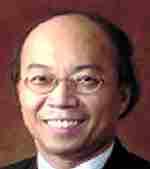
He follows in the footsteps of telephone inventor Alexander Graham Bell in becoming a fellow of the London-based institution, Europe's largest professional engineering society.
Only one or two honorary fellowships are awarded each year.
Professor Er, 49, was chosen for his work in engineering research and education. He contributed to the growth of the school as dean of NTU's School of Electrical and Electronic Engineering from 1996 to May this year. The number of academic staff at the school has increased from about 100 in 1996 to 270, making it one of the largest worldwide. Under Prof Er's watch, the number of PhD and master's students grew from about 100 to 700.
Prof Er has been at NTU for about 20 years, and published more than 240 papers in international journals and conferences.
He is on the boards of organisations such as DSO National Laboratories and SP PowerGrid. IEE president John O'Reilly said he helped strengthen NTU's 'research expertise in a number of leading-edge technology areas'. He has also helped develop NTU's research facilities and forged ties with leading international partners.
Prof Er received his award at a ceremony in London yesterday.
Even though engineering is becoming less popular among students here, he said it 'will continue to provide the core technology for many innovations and inventions, including life sciences'.
HO AI LI
The Straits Times Interactive, 15 September 2005
Wednesday, September 14, 2005
Seawater fit for drinking now a reality
PM hails milestone in history of S'pore's water supply' . Water from the sea that is safe to drink and affordable. OPENING TOAST: In tune with the celebratory mood, fireworks lit up the sky over Tuas as Mr Lee completed a tour of the plant with (from left) PUB chairman Tan Gee Paw, Environment and Water Resources Minister Yaacob Ibrahim and Hyflux's Ms Lum. The bottles have labels saying "Desal H2O". -- Photo by TERENCE TAN
That is now a reality, and in record time too, with yesterday's opening of the first plant in Singapore to turn seawater into drinking water.
Before some 600 guests, Prime Minister Lee Hsien Loong turned on the tap at the desalination plant in Tuas, one of the world's largest. Built by homegrown water-treatment firm Hyflux, it was finished just 20 months after construction began in January last year, and three months ahead of schedule. Its opening is a milestone in the history of Singapore's water supply, Mr Lee said.
Over the next few days, the purified seawater will flow to homes and businesses in the west after it is mixed with water from reservoirs. The $200-million plant can meet up to 10 per cent of Singapore's daily water needs. Its energy-efficient design allows it to supply desalinated water at one of the cheapest rates in the world: 78 cents per cubic metre, about half the cost elsewhere.
Desalination is the fourth national tap in Singapore's plan to ensure it does not become too reliant on any one source for water. The other three taps are local reservoirs, water from Johor and NEWater. With all four national taps flowing, Mr Lee said Singapore will have a 'diversified, reliable and cost-effective supply of water'.
He also announced an investment of S$1.5 billion over the next two years to further develop water infrastructure through projects such as the Marina Bay reservoir and NEWater factories. A smiling Mr Lee led dozens of MPs in a toast as they held aloft small bottles labelled 'Desal H2O'. It was reminiscent of scenes from three years ago, when Singapore also took a giant stride towards self-sufficency in water supply with the launch of NEWater.
Earlier, Mr Lee spoke of how far Singapore had come in tackling its water challenge. He put it down to the determination and ingenuity of its people. All Singaporeans did their part over the years to conserve and make the most of water resources.
'We must continue to work together to secure our future water needs. For Singapore, water will always be a strategic resource, and not just an economic commodity,' he said. But this vulnerability also became a strength, as the water industry grew into a dynamic part of the economy.
Hyflux, which started out as a small-scale water treatment company, has built its capabilities through research and development (R&D) and is now expanding overseas. Others, such as Keppel Engineering, SembCorp and Aromatrix Technologies, have also grown, he said. And international water firms are setting up here, to partner the Public Utilities Board in pilot R&D projects and to test new technology.
'As our water industry grows, it will not only benefit our economy and provide jobs for Singaporeans, but also give us a more robust and resilient water supply.'
Despite rising oil prices, Hyflux chief executive Olivia Lum is confident of supplying desalinated water at the same price for the next three years. This is because the firm hedged or insured itself against fuel-price hikes.
Potong Pasir opposition MP Chiam See Tong said it was good for Singapore to be less dependent on Malaysia for water: 'It will help the relationship. Both sides would be more amenable to speaking rationally rather than playing politics.'
Lydia Lim
lydia@sph.com.sg
Senior Political Correspondent
The Straits Times Interactive, 14 September 2005
Tuesday, September 13, 2005
Thanks for hurricane aid
AS AN American living in Singapore I want to express my heartfelt gratitude for Singapore's quick and generous response to the Hurricane Katrina disaster.
Your unselfish assistance, whether it be during last year's tsunami that was close to your shores or Katrina on the other side of the world, is commendable.
Dr Thomas Chandler
STForum, The Straits Times Interactive, 13 September 2005
Monday, September 12, 2005
Singapore becoming wellspring of water expertise
Locally gained knowledge being used to develop overseas projects.
DEEP in the recesses of a nondescript building on Singapore's Havelock Road, engineers William Yong and Alastair McNeil are hard at work designing two state-of-the-art water treatment plants. Nothing remarkable about that - except that the plants will be built not here, or even in Asia, but in the American states of Texas and Illinois. SOPHISTICATED APPROACH : "With so many projects in Singapore that have made use of sophisticated technology, we are clearly in a position to export our expertise." MR WILLIAM YONG, local director of engineering firm Black & Veatch, with the design for the Panther Creek plant in Texas, which will be built in the US under direction from the office in Singapore. -- Photo by MUGILAN RAJASEGERAN
For years, while Singapore built its vast network of water pipelines and treatment plants, it imported expertise. Now expertise developed here is being applied to overseas projects. Buoyed by easy access to capital, a rapidly growing regional market and a Government eager to try out new technologies, Singapore is fast becoming a centre for excellence in the water industry.
Mr Yong is the local director of United States engineering firm Black & Veatch. The firm has already implemented numerous water projects in Singapore, and he says he is not surprised his company landed the US municipal contracts. 'With so many projects in Singapore that have made use of sophisticated technology, we are clearly in a position to export our expertise,' said Mr Yong.
One of the US projects, for instance, involves treating water using membranes, considered a superior technology to conventional filtration methods. 'While membrane technology is only becoming popular elsewhere now, Singapore has been using it for years,' said Mr Yong.
Black & Veatch is by no means the only firm exporting its locally acquired expertise. CH2M Hill, another American engineering firm, was chosen to help design Singapore's Deep Tunnel Sewerage System. Now it has sent project engineers from Singapore to help build a similar system in Seattle and Minnesota. The company is also aiming to capture more tunnelling and water treatment projects in Australia, Hong Kong and the US, said its director Tan Ngo Chiaw.
Local company Hyflux is another major player. Its subsidiary SingSpring just completed a desalination plant at Tuas, the largest of its kind in the world, making drinkable water out of sea water. The plant, which will be officially opened tomorrow, was designed by Black & Veatch.
Hyflux is now building other water treatment plants in China and Dubai.
Indeed, the mood in Singapore's water industry can perhaps best be described as buoyant. Membership of the Singapore Water Association has gone from 36 to 81 since its inception last December. The association provides a platform for industry players to network and share ideas and technologies.
The timing of this boom is perfect, coinciding as it does with looming threats of a global water crisis, rampant desertification and water pollution. The United Nations says 1.1 billion people - or about one in every six people worldwide - already have insufficient drinking water. And the number is likely to deteriorate to one in four by 2050.
Small wonder then that the Economic Development Board is trying to develop the industry into a key revenue spinner by helping local players spread their wings overseas and enticing foreign companies to relocate.
Siemens Water Technologies has already been convinced. It is in the process of transferring much of its technological and manufacturing expertise from the United States and Germany to Singapore. 'Asia is after all the fastest growing market in water technologies,' said the company's vice-president Jagannath Rao. 'So rather than conduct business here through our offices half a world away, we thought it made better sense to set up shop here.'
Radha Basu
radhab@sph.com.sg
The Straits Times Interactive, 12 September 2005
World's largest seawater desalination plant opens tomorrow in Tuas, Singapore
SINGAPORE'S COME A LONG WAY.
SINGAPORE'S growing clout as a water technology centre is reflected in two milestones this week: the opening of a large international conference on water technologies today, and the official opening of the world's largest seawater desalination plant at Tuas tomorrow.
Minister for the Environment and Water Resources Yaacob Ibrahim is due to open the prestigious International Desalination Association World Congress this morning. More than 600 delegates are in town for the event, which is being held in Singapore for the first time in its 20-year history.
An exhibition of new desalination technologies and projects, being held in conjunction with the conference, was opened by the Senior Parliamentary Secretary in the Ministry of Environment and Water Resources Koo Tsai Kee last night. Fifty-eight foreign and local companies are taking part.
The Tuas desalination plant will be inaugurated by Prime Minister Lee Hsien Loong tomorrow.
Radha Basu
radhab@sph.com.sg
The Straits Times Interactive, 12 September 2005
Saturday, September 10, 2005
HURRICANE KATRINA : S'pore copters help to dam broken levees
SINGAPORE'S Chinook helicopters are winding up a week-long relief mission in hurricane-ravaged New Orleans even as American police and army troops prepare to evacuate remaining residents by force. PLUGGING THE GAPS: A Singapore helicopter drops sandbags to fill the breach in a damaged levee in New Orleans, one of its final vital tasks in a week-long mission. -- AP
Four Chinooks and 45 air force personnel who fly and maintain the helicopters will soon return to their training base in neighbouring Texas after the successful mission in the hurricane-ravaged city, said the Ministry of Defence last night.
Before leaving New Orleans, the Chinooks joined helicopters from the United States military and US Coast Guard for one last critical task - damming up the broken flood barriers, called levees, in New Orleans.
The helicopters are from an RSAF training detachment, codenamed Peace Prairie, which trains alongside the Texas Army National Guard. It was set up in 1995 to train RSAF personnel to fly, operate and maintain the air force's most powerful transport helicopters in the town of Grand Prairie, in neighbouring Texas.
In New Orleans, US police and army troops stepped up pressure on holdout residents to obey a mandatory evacuation order. Officials said the time was nearing for police to exercise their authority to compel people to abandon their homes.
'It will be a forceable evacuation - not that we will use force, but it will be mandatory,' said Chief Deputy Sheriff Anthony Fernandez.
Lieutenant-Colonel Kevin Rodrigues, 41, the Peace Prairie detachment commander who led Singapore's hurricane relief mission, said yesterday that the RSAF Chinooks had carried a total of 226 tonnes of cargo - mostly sand to shore up broken levees - during the week-long mission. They also airlifted relief supplies, such as food, fresh water and medicine.
Each Chinook can carry three giant sandbags, weighing more than nine tonnes, using three cargo hooks on its belly. A flight engineer and aircrew specialist stand at the open rear cargo camp of the Chinook to guide the pilot over the levee breach as the helicopter hovers low over the murky water.
'It's not a precision operation. We try to drop the sand bags between the two broken ends and dump more and more sand until the sand is above the water level,' said Lt-Col Rodrigues. Once enough sand is dumped into the breach, US Army engineers use machinery such as bulldozers to seal the opening with more sand.
Lt-Col Rodrigues, a pilot for 22 years, said Chinooks operate like aerial cranes. A trip from the sand bag preparation site to the broken levees takes just 10 minutes and Chinooks make multiple trips from dawn to dusk each day, he said. At the start of their mission, the RSAF Chinooks airlifted more than 620 residents from the city.
Major Kevin Wee Kim Aun, 33, an RSAF officer involved in the operation, said: 'The high points of this humanitarian assistance and disaster relief operation must certainly be the looks of relief and appreciation on the faces of the evacuees when we flew them from the flooded areas to temporary living quarters set up by the US Federal Emergency Management Agency and the US Army.'
David Boey
dboey@sph.com.sg
The Straits Times Interactive, 10 September 2005
The Moral Home for the Aged Sick - where the aged sick get more than just nursing care
In the seventh part of our weekly series on charities here, The Straits Times looks at the Moral Home for the Aged Sick, which has been tirelessly providing nursing care to needy elderly citizens since 1986.
HELPING HAND: Madam Chan, 83, who was partially paralysed by a stroke six years ago, is one of 33 residents whose stay at the home is paid for. -- PHOTO: ASHLEIGH SIM
MADAM Chan Sock Chiang has helped others all her life, but she now needs a lot of care herself. Six years ago, the confinement maid suffered a stroke which left the right side of her body paralysed. She couldn't walk, or even go to the toilet on her own. Madam Chan, now 83, was then living in a one-room rental flat in Ang Mo Kio with her unmarried son, who worked as an odd-job labourer and could not care for her full time.
But then a relative took her to the Moral Home for the Aged Sick, and Madam Chan was finally able to get all the help she needed.
'I was so handicapped, I couldn't even move my right arm. Luckily the home tolong (helped in Malay) me,' she said of the home, one of the welfare projects run by the inter-religious Chee Hoon Kog Moral Promotion Society.
She is one of 115 residents at the home, which was first set up in a refurbished community centre in 1986, catering to only 26 residents before moving into its current premises in Jalan Bilal, off Bedok Road, in 1994.
Now, it can take in up to 120 residents as well as five day-care patients.
Thirty-three residents, including Madam Chan, do not pay for their stay - the Government contributes $260 a month while the home subsidises the rest. It also gives each of them $20 a month as pocket money.
The others pay between $500 and $1,100 monthly, with the home offsetting part of the fees for about half of them.
The residents - most of them above 75 years of age and suffering from illnesses such as diabetes, high blood pressure or dementia - are looked after by nurses and attend daily physiotherapy sessions.
For recreation, they play games such as mahjong and bingo, or just watch television. Wednesdays are special - they get to watch action movies such as Hong Kong martial arts flick Once Upon A Time In China.
On some days, they get to go out, chaperoned by volunteers, who also organise activities such as singing performances or simple games.
The home needs about $1 million a year for operating expenses - which it gets through government subsidies, fees and donations from individuals and organisations, such as the United Workers of the Electronics and Electrical Industries, an employees' union.
Some people walk in to give 'a couple of hundred dollars' or food such as cakes or buns, while others donate red packets from their wedding dinners, said society chairman Lee Kim Siang.
'We are very particular in our spending. We don't gasak (do it without thinking). We give good quality service but we cut down on wastage,' said Mr Lee, who also chairs the Thye Hua Kwan Moral Society, which runs social services.
The home's main expenses are the wages paid to staff, food, medicine and items like adult diapers. While the home can do with donations of equipment such as oxygen tubes, Mr Lee does not foresee any need to start active fund-raising soon - in fact, it has never felt the need to do so.
'Singaporeans are very kind. If you're doing a good job, people will see.'
Ho Ai Li
hoaili@sph.com.sg
The Straits Times Interactive. 10 September 2005
Charity facts
Name: Moral Home for the Aged Sick
What it does: Help the elderly who are wheelchair-bound and have illnesses such as stroke or high blood pressure.
Money it needs each year: About $1 million
How it raises funds: It does not hold fund-raising activities but gets government subsidies, fees from residents, and donations from individuals and organisations
Office premises: 1 Jalan Bilal, off Bedok Road
How much it has in reserves: Nothing. The Chee Hoon Kog Moral Promotion Society gives it $100,000 each month for operating expenses. The society spends about $4.35 million a year running 15 welfare and community services and has reserves of about $6 million.
Staff: 43 nursing and administrative
Volunteers: About 40 active ones
Is it online? Yes, at www.chkmps.org.sg
Why you should donate: It provides nursing care and meals for the aged sick, many of whom cannot afford such care
Who to contact if you want to help: Call the home on 6441-0619/6442-2268 or e-mail lilian@chkmps.org.sg